The True Cost of an In-House Web Scraping Engineer in the US: Salary, Proxies, Infrastructure and Maintenance Time
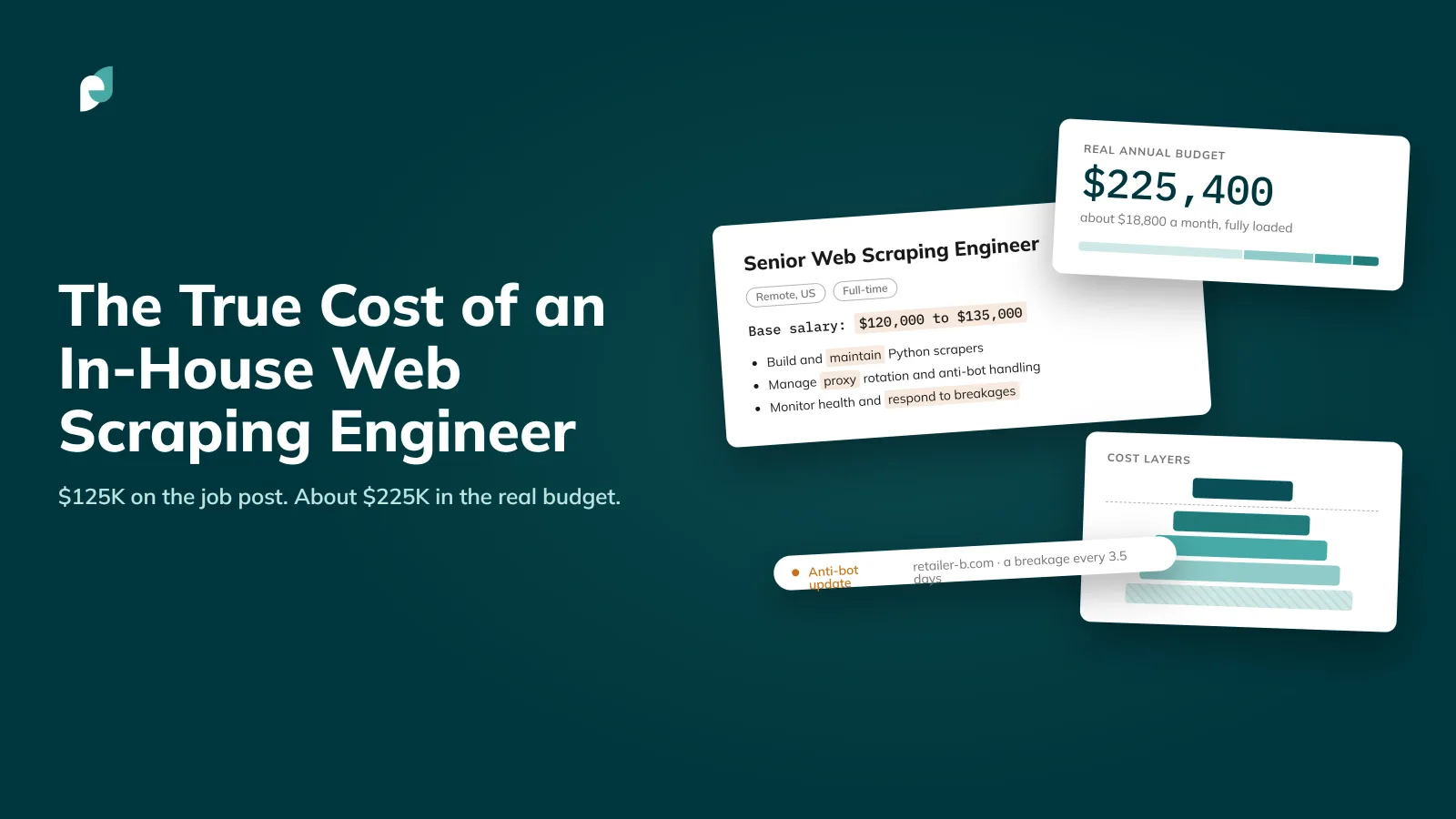
The job post says $125,000. The finance model copies that number across. Twelve months later the real spend is closer to $225,000, half the engineer's week goes to keeping old scrapers alive, and the pipeline stops every time they take a holiday. Here is where the money goes, with the sources behind each figure, and a calculator you can run on your own numbers.
In this article
The short version
- US web scraping engineers earn a median of about $126K in total pay; the 90th percentile is around $170K.
- Benefits and payroll taxes add roughly 30% on top. Residential proxies run $3.50 to $8 per GB. Infrastructure for a daily, 40-source operation is another $15K to $25K a year.
- The biggest line is the one nobody budgets: maintenance. Sources change layout about 2.6 times a year each, so at 40 sources something breaks roughly every three or four days.
- Fully loaded, one engineer running 40 daily sources costs about $225K a year, and the company still has a single point of failure.
The number on the job post is not the cost
We talk to a lot of data-product companies at the moment when they decide to bring web data collection in house. The reasoning is always sensible. The product depends on data from forty or so websites. A vendor feels like a dependency. An engineer feels like an asset. So a job post goes up, and the budget line underneath it says $125,000.
That number is true, and it is also the smallest surprise you will get in the first year. The in-house web scraping cost is really five costs stacked on top of each other, and the job post only shows the top one.
Senior Web Scraping Engineer
Base salary: $120,000 to $135,000 + equity + benefits
You will own collection for ~40 marketplaces and listing sites that feed our pricing product.
- Build and maintain Python scrapers for JavaScript-heavy sites
- Manage proxy rotation, anti-bot handling and retry logic
- Monitor pipeline health and respond to breakages
- Validate data quality before delivery to Snowflake
Read the responsibilities again. Three of the four bullets describe keeping things running rather than building anything new. That is the pattern we see on almost every post for this role, and it tells you what the job becomes after the first few months.
Layer 1: web scraping engineer salary in the US
Start with the visible number, because even that one is usually underestimated. Scraping is a specialist skill. A good scraping engineer is a backend developer who also understands browser fingerprinting, proxy networks, anti-bot vendors, HTML parsing at scale and the quiet ways a dataset goes wrong. That combination is not common, and the market prices it accordingly.
- Glassdoor puts median total pay for a US web scraping engineer at $126,093, with a typical range of $98K to $163K. Base pay runs $82K to $133K, with the rest in bonus and equity.
- ZipRecruiter (August 2026) lists an average of $122,736, with the 25th percentile around $106K, the 75th at roughly $139K and the 90th at $170,000.
Those two sources agree closely enough that we use $125,000 as the working salary for the rest of this article. If you are hiring in San Francisco, New York or Seattle, or you need someone who has already beaten the anti-bot stack on the sites you care about, expect to land nearer the 75th percentile. Note also that the cost to hire a web scraping developer includes the search itself: this is a niche role, and in our experience a search runs two to four months, often with a recruiter involved.
Layer 2: benefits, payroll taxes and the hire itself
Salary is what the employee sees. The employer pays more. According to the Bureau of Labor Statistics, benefits were 30% of total compensation for private-industry workers in June 2026 ($14.07 of every $46.89 per hour). That works out to about $43 of benefits for every $100 of wages across the whole economy. For a single well-paid tech hire the percentage is lower because health insurance is a flat cost and Social Security is capped; Foothold America's 2027 budgeting model lands at about 26% on top of a $120,000 salary, or roughly $151,000 all in.
Where does it go? Employer FICA at 7.65%, state and federal unemployment, workers' comp, an employer share of health insurance of roughly $15,000 per employee (Aon projects total plan cost above $19,000 for 2027), and a 401(k) match that Fidelity puts at an average 4.8%. We use a round 30% in the model to leave room for equipment, software seats and the odd conference.
Then there is getting the person in the door. An agency fee on a $125K hire is typically 20% to 25% of first-year salary. Even if you hire direct, somebody senior spends weeks screening take-home tests. Amortised over a two-year stint, call it $10,000 to $15,000 a year. Which raises the uncomfortable point: two years is a fairly normal tenure for this role, and when the engineer leaves, the scrapers they wrote usually leave with them in every way that matters.
Layer 3: proxies, unblocking and the sites that fight back
This is the first cost that genuinely surprises people, because it scales with the sources rather than the headcount. Any site worth scraping daily (marketplaces, listing portals, travel sites, anything behind Cloudflare or Akamai) will block datacenter IPs within hours. The engineer will move those sources to residential proxies or an unblocking API, and from then on you are paying for bandwidth.
Residential proxy pricing in 2026, from AIMultiple's proxy pricing comparison: Bright Data and Oxylabs charge $8 per GB on pay-as-you-go plans, dropping to around $3.30 at very high volume; Decodo (formerly Smartproxy) sits at $3.50 to $3.75; Webshare at $2.75. A realistic blended rate for a company buying a few hundred gigabytes a month is $3.50 to $5 per GB.
Now do the arithmetic for a modest setup. Fifteen protected sources, 5,000 pages a day each, 250 KB per page once you have blocked images and fonts. That is about 19 GB a day, 560 GB a month, roughly $2,250 a month at $4 per GB. Add a small datacenter pool for the easier sites and you are at $27,000 to $28,000 a year before anyone has written a line of code. Heavier pages or hourly refreshes double it. If you want a deeper look at how the proxy types differ, our guide to proxies for web scraping covers it.
Layer 4: infrastructure and monitoring
Scrapers do not run on a laptop. A daily operation across forty sources needs a scheduler, a fleet of headless browsers (which are memory hungry), a queue, somewhere to store raw HTML for re-parsing, a database or warehouse landing zone, logs, alerting, and a dashboard someone will actually look at. In our own delivery work this runs $1,000 to $2,500 a month on a major cloud for a 40-source daily setup, depending on how many sources need a real browser. Call it $15,000 to $25,000 a year.
The money is the smaller issue. The bigger one is that your scraping engineer is now also your DevOps engineer for this stack, and every hour spent on a stuck Kubernetes job is an hour not spent on data. We wrote about what a proper setup looks like in how to build infrastructure for enterprise data extraction; the short version is that it is a product in its own right.
Layer 5: maintenance time, the cost nobody budgets
Everything above is at least predictable. Maintenance is the layer that quietly eats the hire, and it deserves the longest look.
Websites change. They redesign, they A/B test, they rename a CSS class, they move a price from a span into a JSON blob, they add a new bot check. One team tracking 14 marketplaces, cited in Phyllo's failure-rate analysis, logged nine structural changes in a single quarter, which works out to about 2.6 breaking changes per source per year. That sounds manageable for one site. It is not manageable for forty.
Bar length = days between breakages. Assumes 2.6 structural changes per source per year (Phyllo, 2026). Bars are to scale.
Each break is not a five-minute fix. Someone has to notice it (often a customer notices first), work out which of the forty sources it is, understand what changed, patch the parser, re-run the backfill and check the output. ProWebScraper's time audits put a single incident at 50 minutes to 4.5 hours, and their estimate for a 50-site daily operation is 850 to 1,300 hours a year of maintenance work once you include validation, infrastructure, ad hoc requests and the coordination around all of it. They also cite SOAX's figure that 20% to 30% of engineering time goes on scraper maintenance, and Grepsr's benchmark of about five hours a week of break-fix per engineer. In our own experience with clients who have tried this, the 40-source case lands at roughly 800 hours a year, about 40% of one engineer's working time.
Pause on what that means for the business case. You hired a $125K engineer to expand coverage. By month six, two days of every week are spent keeping the existing forty sources alive, and new source requests join a queue. The person is working hard. The output still looks like a half-time hire.
And there is a worse failure mode than a scraper that stops. A scraper that keeps running and returns wrong data, because a field moved and the parser now reads a blank, or a currency symbol, or last week's price. Phyllo's analysis models a silent failure running for an average of 3.5 days with weekly checks and 15 days with monthly checks. At 10,000 records a day, that is 35,000 to 150,000 bad records in your warehouse, or in front of your customers, before anyone asks why the numbers look odd. We cover the four ways this happens, and the nine checks that catch it, in why web scrapers break; our article on cleaning and normalising scraped data walks through the validation side. Either way, somebody has to own running them every day.
| Source | Status | Change detected | Repaired | Records |
|---|---|---|---|---|
| marketplace-a.com | Healthy | — | — | 184,210 |
| listings-portal.co.uk | Schema drift | Tue 03:40 | Tue 11:15 (7.5 h) | 61,044 |
| ota-rates.com | Healthy | — | — | 92,870 |
| retailer-b.com | Anti-bot update | Thu 09:02 | Thu 17:30 (8.5 h) | 40,318 |
…36 more
Want to see what the maintenance load looks like on your sources?
Send us your source list and we'll return a free source audit: which sites are protected, how often they change, and what it takes to keep them stable.
Calculator: in-house web scraping cost on your numbers
The defaults are the worked example below: one engineer, 40 daily sources, 15 of them behind bot protection. Change them to match your plan. Everything is computed in your browser; nothing is sent anywhere.
Model: 30% on-costs, a 20% recruiting fee over a two-year tenure, $3,000 of seats and equipment, residential bandwidth at 30 days a month plus a $100/month datacenter pool, and cloud at $600/month plus $25 per source. Maintenance assumes 2.6 breaking changes per source per year and about 20 engineer-hours per source per year. A sizing model, not a quote.
The worked example, line by line
With the calculator's defaults (one engineer, 40 sources, 15 of them protected), the first-year picture looks like this:
| Cost line | Basis | Per year |
|---|---|---|
| Base salary | Median of Glassdoor and ZipRecruiter, rounded | $125,000 |
| Benefits, payroll tax, equipment | 30% on-cost (BLS 30% benefit share; Foothold 26% at $120K) | $37,500 |
| Recruiting, amortised | 20% agency fee over a two-year tenure | $12,500 |
| Software seats, laptop, training | Typical allowance | $3,000 |
| Proxies and unblocking | ~560 GB/month residential at $4/GB, plus datacenter pool | $28,200 |
| Cloud infrastructure and monitoring | $600/month base + $25/source/month | $19,200 |
| Total in-house web scraping cost | One engineer, 40 daily sources | $225,400 |
That is about $18,800 a month, or 1.8 times the salary line. And roughly 40% of the engineer's hours inside that figure are going to maintenance, which means the effective cost of the part of the job you actually hired for (new sources, better coverage, data your product does not have yet) is well over $300K per productive engineer-year.
What one engineer can't give you, at any price
Suppose you accept the $225K. There are still four things a single hire structurally cannot provide, and each one tends to surface at the worst moment.
Coverage when they are away
Scrapers break on Saturdays and during annual leave. If your product refreshes daily, a two-week holiday is ten missed deliveries with nobody able to fix them. Most teams discover this during the first December.
Someone to check the work
When the person who wrote the parser is also the person validating its output, silent errors survive. Separation between build and QA is standard practice everywhere else in data engineering; it is almost never budgeted for in a one-person scraping function.
Three skills in one head
Beating anti-bot systems, writing resilient parsers, and delivering clean Parquet to Snowflake are three different specialisms. The engineer who is excellent at the first is rarely the one who enjoys the third. You end up hiring for one and tolerating the other two.
Continuity when they leave
Two years in, the engineer gets a better offer. The scrapers are in a repo, but the knowledge of why source 23 needs a 4-second delay and a specific header is not. The replacement spends their first quarter rediscovering it, while the data degrades. For a product company, this is a revenue event, not an HR one.
In-house vs outsourced web scraping: three honest options
None of this means in-house is wrong. It means it is a specific choice that makes sense in specific situations. Here is how we'd lay out the three realistic options for a US data-product company that needs daily data from twenty to a hundred sources.
| In-house engineer | Freelancer or per-project vendor | Dedicated managed team | |
|---|---|---|---|
| Annual cost, 40 daily sources | ~$225K fully loaded | Low upfront; maintenance billed per fix | Fixed monthly fee, infrastructure included |
| Who fixes breakages | The one engineer, when available | Whoever you can reach, at their rate | Team on rota, 4-hour detection, 24 business-hour repair SLA |
| Proxies and infrastructure | You buy and run it | Usually you | Included |
| Independent QA on every delivery | Rarely | No | Yes, six validation layers |
| Holiday and sickness cover | None | None | Built in |
| Time to first data | 3 to 5 months (hire + build) | Weeks | Day five of the pilot |
| Ownership of code and data | Yours | Varies, check the contract | Yours, including if you leave after the pilot |
| Best when | Scraping is your core IP, or you need under ~10 sources | One-off dataset, no refresh needed | Data is critical and must arrive every day |
The in-house route wins when web data collection is genuinely the thing your company is best at, or when the source count is small enough that maintenance stays a background task. For everyone else, the question is whether you want to run a scraping operation or just receive the data.
A dedicated data acquisition team, with the maintenance built in
This is the model we built DataDwip's dedicated data acquisition teams around, because it answers the five layers directly. Instead of one engineer and a pile of invoices, you get:
- Three scraping engineers assigned to your sources, a QA lead who does not write the scrapers they check, and a delivery manager as your single escalation point.
- Proxies, headless browsers, scheduling, storage and monitoring included in the fee. Layers three and four disappear from your cloud bill.
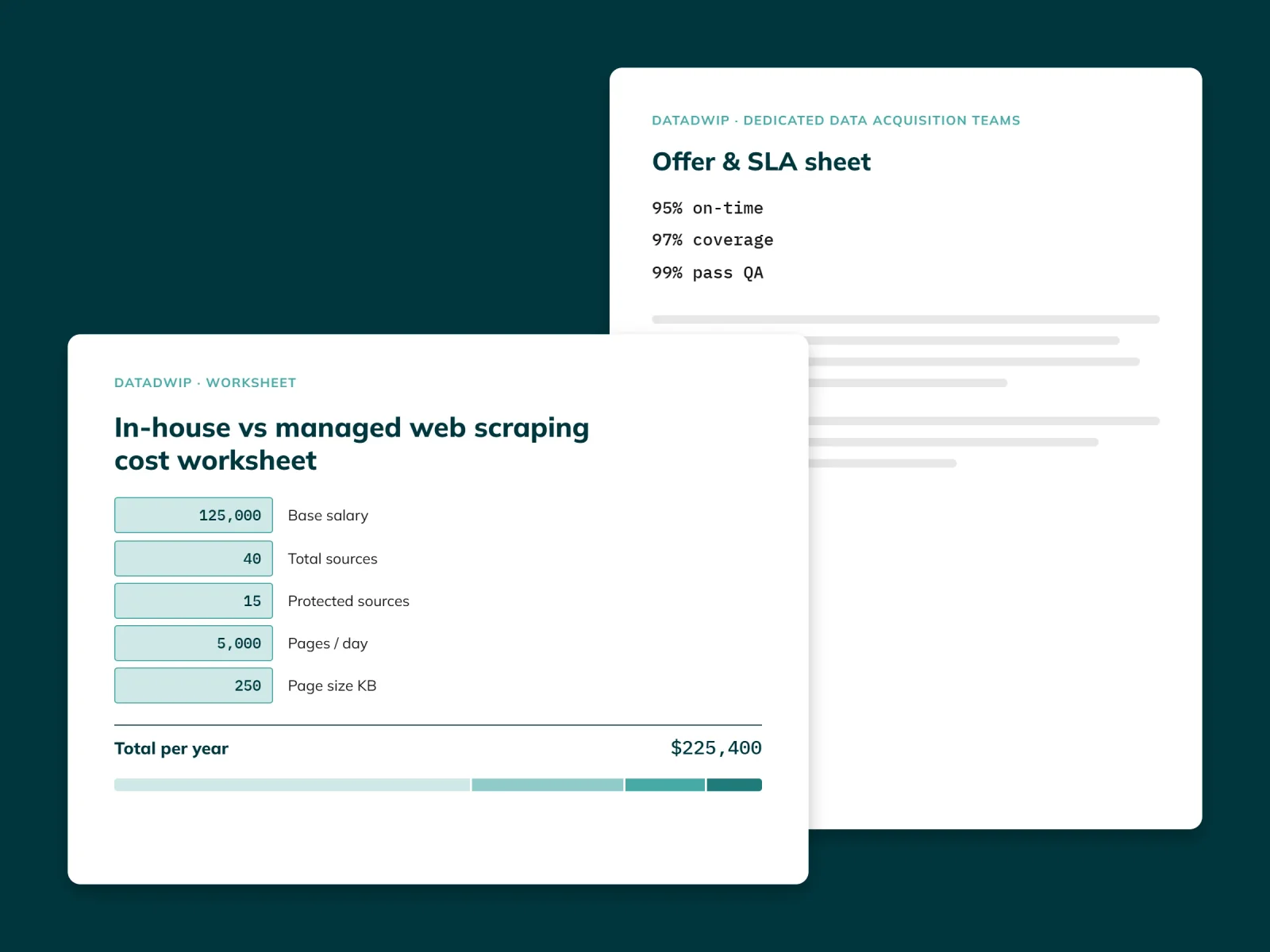
- A written SLA with service credits: 95% of deliveries on time, at least 97% coverage per source per run, 99% of records passing validation, breakages detected within 4 hours and fixed within 24 business hours.
- Delivery in your schema to Snowflake, BigQuery, Redshift, S3, GCS, Azure, PostgreSQL or a REST API, as JSON, CSV or Parquet.
- Up to three new sources a month added within scope, and a weekly source-health digest like the one shown earlier, so you see the maintenance rather than paying for it blind.
On price, the team runs on a fixed monthly fee scoped to your source list. In most engagements of this size it comes in below the fully loaded cost of the single hire modelled above, and the comparison gets more lopsided as the source count grows, because the team's cost scales with sources while an in-house function scales with headcount.
Risk per source
First data on day 5
3-month minimum
Weekly digest
If SLA targets are missed, or you decide not to continue: you keep the code and the data.
Two examples of what this looks like in production: a daily hotel rate pipeline across OTAs for a travel pricing team, and a continuous tyre pricing feed for an automotive manufacturer. Both are the kind of daily, many-source, protected-site workloads where the maintenance layer decides whether the project survives.
If you just need a one-off dataset rather than an ongoing feed, our web scraping services page is the better starting point. For very large crawls, see enterprise web crawling. Either way, every source goes through a terms and robots review first; we only collect public data and no personal data by default, which we explain in web scraping laws and ethics.
The in-house vs managed cost worksheet, plus the Offer & SLA sheet
A spreadsheet version of the calculator, with every assumption editable and sourced, so you can put it in front of your CFO. Sent together with the six-page Dedicated Team Offer & SLA sheet.
 What's inside
- The cost worksheet: salary, on-costs, proxies, infrastructure, maintenance hours
- A side-by-side with a managed team at your source count
- The SLA table we sign
- The pilot scope and scorecard template
Frequently asked questions
How much does a web scraping engineer earn in the US?
Median total pay is about $126,000 according to Glassdoor, with ZipRecruiter's average at $122,736. The 25th percentile sits near $106,000 and the 90th near $170,000. Senior people with anti-bot experience in major tech hubs are usually at the top of that range.
What is the real cost to hire a web scraping developer, fully loaded?
Add roughly 26% to 36% for benefits and payroll taxes, a recruiting fee of 20% to 25% of salary if an agency is involved, then the operating costs the engineer creates: proxies ($2,000 to $5,000 a month for daily protected sources), cloud infrastructure ($1,000 to $2,500 a month) and the roughly 40% of their time that goes to maintenance. For 40 daily sources we land at about $225,000 a year.
How much do proxies for web scraping cost?
In 2026, residential proxies run from about $2.75 per GB (Webshare) through $3.50 to $3.75 (Decodo) to $8 per GB pay-as-you-go at Bright Data and Oxylabs, with volume discounts at the top end. Datacenter proxies are far cheaper, a few cents per IP, but are blocked quickly by any site with bot protection.
How often do web scrapers break?
Roughly 2.6 structural changes per source per year, based on a team tracking 14 marketplaces. That means a break about every 28 days with five sources, every week with twenty, and every three or four days with forty. Anti-bot changes come on top of that.
When does in-house web scraping make sense over outsourcing?
When collection is your core intellectual property, when you need fewer than about ten sources, or when you already run a platform team with on-call cover and QA. If the data must arrive every day and the source count is in the dozens, a managed team with a maintenance SLA usually costs less and fails less.
What happens to the scrapers if we stop working with DataDwip?
You keep the code and the data. That applies after the pilot and after any dedicated-team term. We think vendor lock-in is a bad reason to stay with anyone.
Ready to compare the numbers on your own source list?
A 4-week pilot starts at $3,000, delivers first data by day five and ends with a scorecard against the SLA. If it doesn't hit targets, you keep everything and owe nothing further.
Related reading
- Glassdoor, Web Scraping Engineer salary, US, 2026
- ZipRecruiter, Web Scraping salary, August 2026
- US Bureau of Labor Statistics, Employer Costs for Employee Compensation, June 2026
- Foothold America, Budgeting a US team for 2027
- AIMultiple, Proxy pricing comparison, 2026
- Phyllo, Why scrapers break: a failure rate analysis
- ProWebScraper, The 800+ hours per year your team doesn't know they're losing
Figures are current as of October 2026 and will be refreshed annually. Model assumptions are described in the text; your numbers will differ.